







 The Industrial Paving Standard: What Facility Managers Must Demand
 The Industrial Paving Standard: What Facility Managers Must Demand
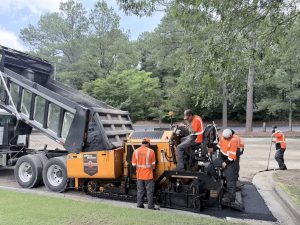
An industrial paving standard is significantly more robust than those of residential and commercial paving. For manufacturing plants, distribution centers, and other industrial facilities, low-quality paving can negatively impact operational continuity, ultimately affecting productivity and weakening the bottom line. At The Surface Masters, we proudly build, maintain, and manage asphalt surfaces for industrial clients throughout Atlanta. We also have a location in Southwest Florida to serve industrial paving needs throughout Fort Myers and the surrounding areas. In this industrial paving guide, you’ll learn about pivotal engineering, construction, safety, and maintenance guidelines you must demand.
How Do Contractors Engineer Paving for Industrial Facilities?
High-quality paving for industrial facilities begins long before a single load of hot asphalt enters the mix. Industrial properties are subject to significantly more stress than standard parking lots and driveways. They face non-stop traffic and heavy-duty vehicles. Thus, typical commercial asphalt paving requirements won’t cut it.
To meet industrial paving quality standards, contractors engineer surfaces to be considerably thicker. They build up that thickness using various asphalt courses and high-density mixes that can evenly distribute weight and prevent damage. But that’s not all.
Contractors also spend more time preparing the site. Tasks like excavation, soil stabilization, and grading often take longer to meet or surpass industrial paving standards guides. This extra time prevents early base failure, safety issues, and costly restoration work.
What Industrial Paving Standards Are Non-Negotiable?
Paving for industrial facilities needs precise engineering to ensure that the finished surface can properly support loads. However, beyond choosing the right materials and thickness, there is one finer detail that you need to review with your contractor before marking them off on your facility manager paving checklist: Drainage.
Standing water is one of the biggest enemies of industrial paving. Commercial asphalt paving requirements typically involve careful grading, drainage design, and new infrastructure. Industrial paving standards guides are even stricter because pooling water can quickly degrade the material, weaken foundations, and accelerate drainage.
During the design and engineering process, contractors should:
• Make precise grading corrections
• Install catch basins and other infrastructure
• Consider overall stormwater management
• Plan water runoff routes
These added steps keep surfaces dry, promoting better longevity and fewer safety concerns.
What Facility Pavement Safety Standards Do I Need to Follow?
There are several facility pavement safety standards to follow. While all parking lots, loading zones, and other properties open to the public need to meet various federal, state, and local codes to remain accessible, industrial paving standards guides focus on workplace safety and accident prevention.
Facilities often operate under strict safety and access rules, and failing to consider how your industrial paving affects those requirements could be a costly mistake. Work with contractors who fully understand:
• OSHA facility pavement safety standards
• TWIC access requirements
• Traffic control planning
• Warehouse floor striping standards
• Local code requirements
Is There a Facility Manager Paving Checklist That Covers Maintenance?
Contractors can work hard to meet or exceed industrial paving quality standards. However, if you’re not investing in ongoing care, it won’t take long for surfaces to show signs of distress.
To maintain quality, work with a contractor to mark off the following tasks on your facility manager paving checklist:
• Surface cleaning
• Crack filling and sealing
• Asphalt repairs
• Asphalt sealcoating
• Pavement marking and striping
It’s also a good idea to schedule routine inspections. Experts can assess your pavement and make valuable care recommendations that count.
What Industrial Paving Standard Help Reduce Downtime and Operational Delays?
Many commercial asphalt paving requirements revolve around operational continuity. The same goes for industrial paving, but on a bigger scale. Industrial properties can’t afford to cease operations for critical pavement work. That’s why it’s so vital to work with paving companies that have the skills and expertise to handle logistically sensitive work.
Reputable contractors perform phased operations, schedule work over nights or weekends, and even fast-track certain tasks based on property availability.
Let The Surface Masters take care of your industrial paving needs. We have a deep understanding of modern industrial paving quality standards and work hard to exceed all expectations. Our team is well-trained and understands how important their work is to supporting your bottom line. No matter your needs, you can count on us to deliver every time.
Our services include new asphalt paving, milling and reclamation, sealcoating, repairs, resurfacing, concrete curbing, crack sealing, pavement markings, and more. Give The Surface Masters a call today at (770) 670-7857 to learn more and request a free quote. You can also use our online form or email Info@TheSurfaceMasters.com